Late to the Party: Assassins Creed Origins
Late to the Party is a series of games reviews for games that released a significant time ago that I still feel the urge to write about. A lot of them have only become available to me this last year and continue to offer me new abilities to explore gaming and different aspects of it. The added benefit is that the games I get to explore are usually completely patched and free of their release day bugs and with most of the DLC already released and even included in the purchase. So please enjoy a fresh perspective on a not so fresh game.

Assassins Creed Origins is the overall 20th
entry in the series and the 10th main game. It was published on
October 27,2017 by Ubisoft and developed by Ubisoft Montreal in Canada. The
game was to overhaul the Assassins Creed formula which had fallen out of
favour. It’s predecessor Syndicate launched under the bad memories of Assassins
Creed Unity. It would receive lots of praise but be ultimately over and over
criticised for the repetitive gameplay that had been with the series since the
first game in 2007 and thus did not up selling to Ubisoft’s satisfaction. This led
to Assassins Creed Origins being developed for more than 4 years, in an attempt to change up the stale formula, leading to a
break in the recent yearly releases.
Assassins
Creed Origins was a game I got for my birthday last year and I originally started
the game sometime in summer after I finished Odyssey. The setting intrigued me
even though I felt wary of too much desert (which I perceive as depressing) and
the fact that it came before the game I had just finished and very much
enjoyed. I knew there’d likely be some changes and I wasn’t sure if they would
work for me.
I was also on a high enjoying the female protagonist I had craved
for forever in an Assassins Creed game. So, despite not knowing the character
yet I wasn’t as excited for Bayek as I had been for Kassandra when I started
Odyssey.
I played
the first third of the game then, mostly alone unlike Odyssey, which my partner
and I played together for all of the story. Then I put it down because I had
bought Horizon Zero Dawn and was much more intrigued by that.
On
Valentine's day we decided to opt for a cosy day in bed, gaming and ordering
pizza. When the time came to choose what to play my partner asked me to get
them up to speed with the story and if we wanted to finish Origins together.
 |
| Thankfully the game is not all desert and uses the lush Nile delta to full capacity |
The story
starts out in a flashback to Siwa, the protagonist’s hometown/region. The city
is busy preparing for the visit of Ptolemy the Pharaoh and we briefly get to
see Bayek in his role as the Medjay. When Bayek spots some masked figures behind
Ptolemys back his expression becomes angry.
The flashback cuts to a scene currently taking place in the bent pyramid, Bayek is killing Rudjek aka “The Heron” the first of the people in masks he was able to track down. He then battles his bodyguard and returns to Siwa
The flashback cuts to a scene currently taking place in the bent pyramid, Bayek is killing Rudjek aka “The Heron” the first of the people in masks he was able to track down. He then battles his bodyguard and returns to Siwa
Through
more flashbacks it is soon revealed that Bayek son Khemu was killed in an incident in Siwa, where a masked man forced a knife in Bayek hands through his
chest while the others watched on. The people in the masks call themselves the
Order of Ancients and Bayek has sworn to kill them all to put his son’s soul to
rest.
On his
quest to achieve this he travels through vast parts of Egypt, finding the Order
of Ancients poisoning the land wherever they established themselves in power.
They are backed by the usurper Pharaoh Ptolemy who stole his sister Cleopatras
throne and Bayek and Aya align themselves with her to right the wrongs and
install her as the rightful ruler.
For most of
the story we follow Bayek, but every now and then we also get to experience the
ancient world through Ayas eyes. Her DNA was damaged (her sarcophagus fell in a
trench and broke open) so we only get bits and pieces as she becomes an even
closer ally to Cleopatra than Bayek and frequently takes on dangerous sea
voyages for her queen.
Aya is out for revenge as well and while less in number, she as well is cutting her way through the Order of Ancients.
Aya is out for revenge as well and while less in number, she as well is cutting her way through the Order of Ancients.
In the end
all their efforts seem futile. Cleopatra wins the favour of Rome’s emperor Julius
Cesar and quickly bans the two from the royal palace since the last Order
member ranks high in Cesar’s court and is thus protected by them.
It is this betrayal that finally leads the pair to start the Creed, and they manage to get their vengeance. However, Aya feels this is not enough, that tyranny like the one that was allowed to grow along Cesar’s reign has to be prevented and so she takes on a new name and travels to Rome where she becomes the first to stab Cesar, a deed that earned her fame through the ages known under her new name: Amunet.
It is this betrayal that finally leads the pair to start the Creed, and they manage to get their vengeance. However, Aya feels this is not enough, that tyranny like the one that was allowed to grow along Cesar’s reign has to be prevented and so she takes on a new name and travels to Rome where she becomes the first to stab Cesar, a deed that earned her fame through the ages known under her new name: Amunet.
 |
| Screenshot from Assassins Creed II, showing Amunet who we came to know as Aya |
Now I have
to say the way the open world is designed and used in Origins and Odyssey is
what made me excited to play Assassins Creed again.
I love free-climbing mechanics and find myself increasingly frustrated by open-world games not offering them. Especially when exploration is a big part of the game. Origins delivered on this making most surfaces climbable, with a few acceptable exceptions.
I love free-climbing mechanics and find myself increasingly frustrated by open-world games not offering them. Especially when exploration is a big part of the game. Origins delivered on this making most surfaces climbable, with a few acceptable exceptions.
The more role-play-oriented design, however, is what made me unable to put the
controller down at certain points. I
love the older games in the series, but they very clearly tell a story that you
follow with little straying from the intended path. Origins is drastically
different. It still tells its story very linear and there is the one ending
that you’ll get if you finish the game, but how and when you get there can vary
a lot.
 |
| Synchronisation points remain in the game and improve Senus perception |
In the end, the open world and wanting to explore it more remained my main motivation to complete the game. The world is built incredibly beautifully, and I loved moving around in it. Quick travel was we rarely used since there might be something cool to discover along the way.
I liked the overarching story but the subplots in between had a tendency to tire me out and I was almost glad when the main game was done because I wouldn’t have to go somewhere, talk to someone, do a sub-quest, realize who the Order member was and go assassinate them (most likely in a temple).
There were a few
boss fights that mixed things up, like “The Hyena” who fought by bow and arrow in
a sandstorm or the fight against Flavius who uses an Apple of Eden, but overall
a lot of the main quest was very similar.
The theme of child death is also used so frequently that it actually became tiring to me at a point where it is yet again brought up to make the stakes seem even higher. Needless to say, that a theme like child death should not be considered tiring and I consider its actuality in the world very cruel. As a plot point in Origins, the death of Khemu was cruel and more than enough motivation to wander Egypt until all those who had a part in it were dead. But then there a child in danger of dying here, unborn children being poisoned there, another child dying as a plot point and it just goes on and on. I got the fact that Bayek was a family man and this event was tearing him apart the first time. I got that he was generally loving kids the second time. The third time I just thought “again?”.
The theme of child death is also used so frequently that it actually became tiring to me at a point where it is yet again brought up to make the stakes seem even higher. Needless to say, that a theme like child death should not be considered tiring and I consider its actuality in the world very cruel. As a plot point in Origins, the death of Khemu was cruel and more than enough motivation to wander Egypt until all those who had a part in it were dead. But then there a child in danger of dying here, unborn children being poisoned there, another child dying as a plot point and it just goes on and on. I got the fact that Bayek was a family man and this event was tearing him apart the first time. I got that he was generally loving kids the second time. The third time I just thought “again?”.
For me, it just didn’t contain the shock value that
the writers might have intended.
I also felt like I saw Bayeks whole story arch coming from very far away. He would avenge his son because that was the goal the player was given to achieve. He would most likely found the Assassins because that is literally in the name of the game. And his marriage would not last and I’m glad it didn’t, it would have felt like cheating a broken relationship fixed. The last point was obvious to me seeing how he and Aya we’re mostly united by anger but had just gone a year without contact no problem. I was unsure for a bit after they united happily in Alexandria but Aya just never seemed as Bayek when they went their own ways again.
 |
| All through his journey, Bayek can find stone monuments |
 |
| The monuments unlock memories with Khemu as well as star signs in the sky |
All that said I still really liked the story. Side Quests brought me more enjoyment since they never had to play into the endgame and could do some cool unexpected stuff. There’s a repetition here as well with how you’ll go about one but the idea behind varies. I loved the quest where Bayek must go and find out why the Natron mines seem haunted ever since he killed the Heron nearby, the residents fully blaming him for murdering in a sacred place. Because in a pious society like ancient Egypt murdering someone in a place dedicated to a god was a sacrilege.
Exploring the Pyramids and graves strewn through Egypt was a special treat.
It’s like a childhood dream come through since I always wondered what it would
be like to wander those monuments and the game made it somewhat experienceable. Although it was a bit funny to run through rooms filled with gold to the brim and collect 10 coins as loot.
Now there
is as always, a modern-day story. I have never been big on those and most people I know aren't either. Layla is an
okay protagonist but I’m most happy when I can be done with her.
In the game
there is a series of hidden ancient mechanisms, which when activated spit out messages
directly addressed to her. Those mechanisms are never ever referred to as important
or a quest objective, instead you might stumble across them or maybe miss them all
for the one that is in the main story mission.
I guess Ubisoft knows by now that
we all are over the modern time stuff and they leave it as optional for people
who are deeply invested in the lore (for which you also must read all the comics
and books).
 |
| The game plays very smooth for the most part but occasionally the boats took to the sky |
Something Origins did very well is the number of weapons to choose from. Loot with
stats is something that motivates me a lot in games and I enjoyed the variety. There
are swords, sickle swords, spears, axes and blunt weapons like maces and
hammers. While my partner favoured a mace at the start, they later found a
flaming sword they took to. I varied between spears and sickle swords the whole
time and when I had to decide what to level stayed with the sickled swords
since I loved the ability to break through shields and the fast and sleek
movement especially when the overpowered mode was triggered.
The bows
are nearly as varied as the melee weapons, which is one of the things I’m most
sad about that they were lost in Odyssey. I took to the predator bows a lot,
which are basically sniper bows, but I also enjoyed the warrior bows that fire
a spread of five arrows at once, especially helpful against multiple opponents
or to take riders off their mounts.
My partner used the predator bows a lot as
well but tended to go with hunting bows, which allow relatively quick
and precise shooting while having a larger quiver. The quiver really was the
only drawback of the whole bow gameplay, fitting only nine predator arrows we
tended to run out very quickly even if we tried to reclaim all the arrows the
game would allow us. Once we were out, we rarely went to a vendor if we were
exploring in the middle of an area right now, relying on either finding some as
loot or our melee weapons.
The gameplay is overall very enjoyable, unlike Odyssey there is not a plethora of
healing mechanics, instead the game rewards somewhat traditional assassin
playstyles. While Bayek can use his tools and eagle to aid that he can
also hold himself in an all-out fight, especially when the blocking mechanic is
properly utilized. But the chances of dying are much higher that way especially
when faced with more than one enemy at once. Unlike the protagonist of Odyssey
who can just stride into a fort and take down the majority of people with a
plethora of godlike abilities.
I loved playing
both of those styles, but I see the fair point people make when they say that
the Assassins style should be OP in Assassins Creed. It’s in the name and all.
However
even without shockwaves and healing options, Origins skill tree is impressive. It has all kinds of cool treats for the player,
a good thing in my book because I’m a big fan of unlocking new skills in games.
The tree is split into three distinct parts: hunter, warrior and seeker abilities. Hunter abilities improve Bayeks skill with the bow and allow for such cool things as guided sniper shots, leaving you in control of the arrow even after you fired it. It's also the part of the skill tree where you can improve your assassin abilities, gaining experience for the kills and automatically looting enemies sparing you to check every pile of hay once you’ve cleared an area.
The warrior abilities revolve around melee fighting, for instance allowing to extend your attack combos or to charge enemies with your shield, and if all that didn’t help to pummel them with overpowered attacks.
Seeker abilities are more divers, for one this branch includes the use of tools, allowing Bayek to vanish in a smokescreen and poison his foes, but there’s also a lot of utility here. For instance, the ability to hold the breath longer and thus explore underwater areas more effectively or to buy certain crafting materials from vendors and get generally better prices from them.
The tree is split into three distinct parts: hunter, warrior and seeker abilities. Hunter abilities improve Bayeks skill with the bow and allow for such cool things as guided sniper shots, leaving you in control of the arrow even after you fired it. It's also the part of the skill tree where you can improve your assassin abilities, gaining experience for the kills and automatically looting enemies sparing you to check every pile of hay once you’ve cleared an area.
The warrior abilities revolve around melee fighting, for instance allowing to extend your attack combos or to charge enemies with your shield, and if all that didn’t help to pummel them with overpowered attacks.
Seeker abilities are more divers, for one this branch includes the use of tools, allowing Bayek to vanish in a smokescreen and poison his foes, but there’s also a lot of utility here. For instance, the ability to hold the breath longer and thus explore underwater areas more effectively or to buy certain crafting materials from vendors and get generally better prices from them.
It was also
interesting to see what changed in comparison with the Odyssey as the later
entry. Bayek can send a wave centred on himself that’ll mark loot and secrets
like doors or interactable objects. The same skill is in Odyssey, though it must
be acquired from the skill tree in that game and upgraded to have wider range.
On the other hand, the character in Odyssey automatically earns experience for killing
by any kind of means while the experience from assassinations and kills with
the overpower attacks have to be bought from Origins skill tree.
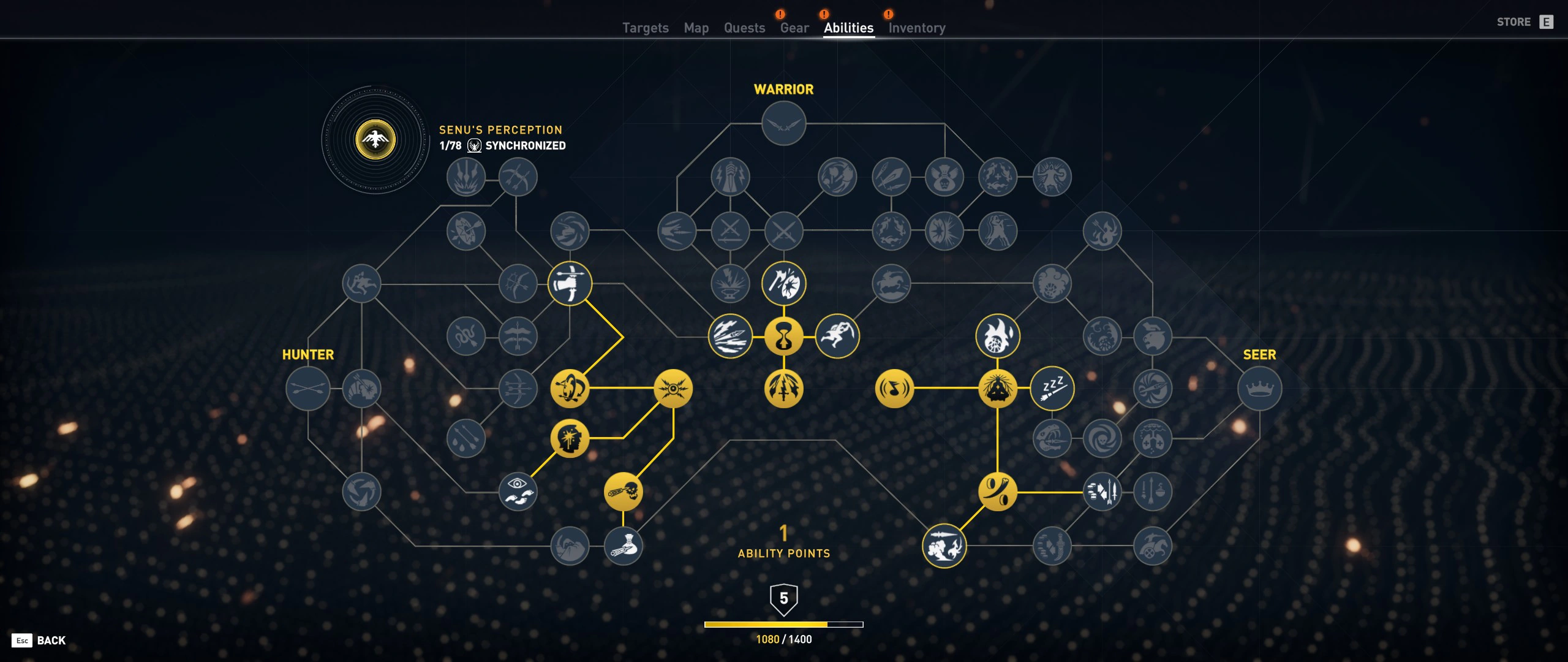 |
| The skill tree at the start of the game |
Something I knew from the follow-up game but love nevertheless is that we have an actual eagle companion. Senu is useful for all kinds of scouting and lands on Bayeks arm for some pets when he starts his idle animation. Being a sucker for animal companions I hope this is something the franchise carries forward, maybe with a raven or something similar thematically fitting in the rumored viking installation.
 |
| Additionally to Senu you get a mount, usually a camel or horse...or even a Chocobo? |
What I came
dearly to miss was my awesome boat from ancient Greek. Origins offers
some ship combat, but it felt clunky and old in comparison to the sleek
navigation of the Adrestia, and I had a lot of o fun investing tons of resources
to level my boat alongside my character. While similar resources have their use
in Origins to update overall armour rating and health (not tied to the outfit
Bayek wears) and damage output in all aspects (hidden blade, melee and bows) it
became an extreme grind towards the end of the game to gather enough for an
update. I never went specifically on a long grind for them but tried to gather
them on my way to different locations instead. Still having a boat and a crew to put these resources into felt more rewarding to me.
At a
certain point it became evident to me that gathering the resources was supposed to be a
boring grind, especially since you could buy them via the in-game shop.
This
shop is another first in Origins and it had a few interesting effects. For one
money was kept very limited to the player, causing you to actually pick and
choose what gear you wanted to level or if buying something was worth it. Since
I played with my partner and we both liked a different weapon and bow it got
annoying, but also surprisingly motivating not to use the shop, but to properly
keep track of expenses. We also started to enjoy the grind as a challenge. The
main material that is scarce are Carbon crystals, those can be bought from an
NPC vendor, but they are beyond expensive which is again a motivation to use
the shop.
The trick here is that technically you never buy resources for real
money, you just buy the game money. In the end, the game was properly playable even
with an unfinished set of upgradeable stats though so while it left a certain
aftertaste it was easy enough to ignore.
I have not
yet played the DLC because I got the game as a gift and I also got burned a bit by Odysseys DLC. Until
there is a sale I will wait to pick that up, but after reading the description
I’m intrigued and hope said sale will come soon.
Playing the
series with my partner is a special treat and makes them even more dear to me,
but even for the parts I played alone Origins entertained me and sucked me
right into ancient Egypt, even if it had a few difficulties to get going.
In the end I came to love Origins. Not as much as I
love Odyssey, for a lot of reasons the game has no influence over, but it’s definitely
one of my favourite Assassins Creed games. There is a ton of stuff I’m happy
was improved in the follow up, and a lot that I will from now on dearly miss in
Odyssey (my sweet predator bow).
For anyone who has not yet picked
the game up but loves games in historical settings that feature exploration and
some gory combat I would recommend giving the game a go to get a feeling if the
new ways of Assassins Creed might be for you.
